How does an empire come into being, and what kind of human being can found it?
In this lecture, historian Dr Barry Strauss offers a portrait of Augustus, the first emperor of Rome, and the world he inherited after a century of upheaval. Beginning with the assassination of Julius Caesar and the turbulence that followed, Dr Strauss traces the ascent of the young Octavius, a figure whose political intelligence, audacity, and ruthlessness enabled him to outmaneuver rivals, secure public favor, and emerge from civil war as the decisive power in Rome.
Strauss then turns to Augustus’s most enduring achievement: the creation of a political settlement that ended the cycle of civil wars while preserving enough republican form to make imperial reality tolerable. Through a mixture of restraint and intimidation, patronage and reform, Augustus reshaped political offices, reorganized military command, and drew provincial elites into a new partnership that could hold a vast empire together. Dr Strauss highlights the role of images, coins, festivals, architecture, and poetry, especially Virgil’s Aeneid, in the project of persuasion by which Augustus made his rule appear as a restoration of order rather than a seizure of power.
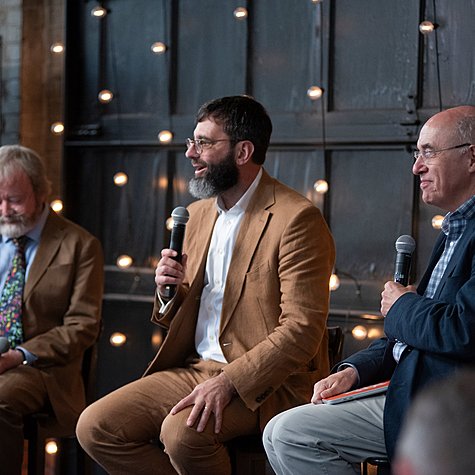
In the closing discussion with students and faculty, the conversation expands into larger territory: the relation between virtue and ambition, the cost of peace purchased through violence, and whether a constitutional republic can cultivate the kind of civic audacity required to preserve itself. Dr Strauss offers a living encounter with the political imagination of Rome, weighing the security of power against the freedom from which such rule emerged.
Applications for Ralston College’s MA in the Humanities are now open. Learn more and apply today at www.ralston.ac/apply